

STORY
BACK
NASH MAYUELA
Cognitive Performance Strategist | Founder, Flow Insider
I build mental operating systems for people who have already proven what they're capable of. That's the work.
HERE'S HOW I GOT HERE
I didn't discover this work. I was thrust into it.
Fourteen years. High-pressure teams. Publishing, tech, media. Building companies from nothing, managing people across continents, making calls where being wrong had real consequences. I was good at it. Genuinely good.
And then I started watching something happen to the best people I knew.
Not the mediocre ones. The exceptional ones. The ones who had already done hard things, already proven something, already built something worth building. They kept hitting a wall that nobody could explain properly. Decisions that used to be instinctive started taking longer. Clarity that used to be reliable started disappearing at exactly the wrong moments. Performance that once felt effortless started feeling like a fight.
I recognized it because I was living it too.
So I stopped looking for answers in leadership frameworks that weren't written for people like us and went straight to the source: the neuroscience of peak performance. Flow psychology. Cognitive load theory. Decision architecture. The actual science of what happens inside the brain when a human being is operating at their limit.
What I found changed everything.
It wasn't a discipline problem. It wasn't a mindset problem. It was an infrastructure problem. The mental architecture that carries you to a certain level of performance cannot, by design, carry you beyond it. You don't need more motivation. You need a rebuild.
I trained at The Flow Centre, the same organization behind the performance systems of Olympians, world champions, and elite teams. What I learned there gave structure to everything I'd been watching for years.
That's what Flow Insider became. Not a coaching business. An engineering practice
WHAT 14 YRS TAUGHT ME
The pattern is almost always the same.
You're not underperforming. You're over-capacity on a system built for a previous version of your life. The founder who took a company from 10 to 80 people and now finds every decision heavier than it used to be. The athlete who has put in every hour of training and still can't access their best when the stakes are real. The executive whose team is watching them for signals they're not sure they can reliably give anymore.
They're not failing. Their infrastructure is.
Nobody told them this would happen. Nobody told them that mental architecture has to evolve the same way everything else does when you scale. So they push harder, work longer, sleep less, and wonder privately why it all used to feel so much more natural.
I know this because I lived inside this problem for years before I had the language to name it. And I know it's fixable because I've fixed it, in myself and in the people I work with.
Not through better habits. Not through another morning routine. Through precision systems that make high performance the baseline instead of something you have to fight for every single day.
THE FOUNDATION
I've led teams across publishing, technology, and media, building companies from early stage, scaling organizations through complexity, and delivering results in environments where precision determined outcomes.
I've managed global remote teams, built strategic partnerships across three continents, driven record revenue performance, and navigated high-pressure environments as both individual contributor and organizational leader.
This operational background is not incidental to my methodology — it is its foundation.
I understand what high-stakes performance demands because she has operated inside those demands, not observed them from the outside.


ON HIGH PERFORMANCE
I run Flow Insider with a deliberately small client list.
Flow Reset is a six-month individual engagement for leaders, founders, and athletes who need their mental operating system rebuilt for the level they're actually at now. Research-backed. Protocol-driven. Built for environments where mistakes cost millions or medals. Eight clients a year. That's it.
Pole Position OS is what I build for teams. I developed it in partnership with Xevi Pujolar, a Formula One Racing Director with 23 years at the absolute pinnacle of motorsport.
We built a methodology that translates Formula One's decision-making architecture, pressure protocols, and team synchronization systems into high-performance business and sports contexts and install them into leadership teams and high-performance organizations.
This isn't culture work. It's precision infrastructure.
The collaboration produces something unique: performance systems field-tested at 300 km/h, applied to the environments where your decisions matter most.
OUTSIDE THE WORK
There's a particular kind of authority that can't be manufactured. It comes from having actually lived across enough contexts, failed in enough markets, rebuilt enough times, to understand that performance under pressure is not a personality trait. It's a set of skills. And skills can be engineered.
I left the Philippines at 28 with a decision and not much else. No safety net, no mapped-out plan, just a clear sense that the life I was building wasn't the life I wanted.
What followed was something most people only talk about: actually doing it. Lived in Singapore, Vietnam, Sri Lanka, and Thailand. Worked with clients across the US, Europe, and Australia. Built businesses in markets that didn't know my name.

I learned to operate in uncertainty because I had no other choice. I reset my life when it needed resetting, and I did it more than once. Each reinvention taught me something the previous version couldn't have.
That's not a story I tell for inspiration.
It's context. Because the people I work with are navigating their own versions of that reinvention, usually under higher stakes and more scrutiny than they'd like. When I say I understand what it costs to perform through uncertainty, I'm not speaking theoretically.
What it taught me most: the people who perform best in unfamiliar territory are not the ones with the most talent. They're the ones with the most reliable internal systems.
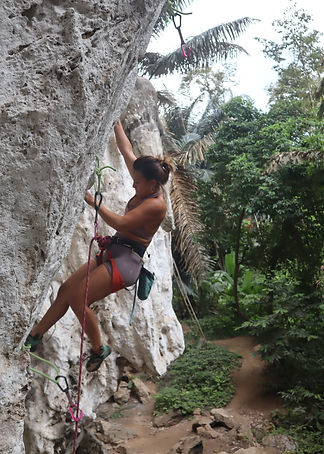
I'm a rock climber. Have been for years. I've also ran a marathon and trained through ashtanga yoga and pilates long enough to know that the body and mind are not separate systems.
Climbing, specifically, has been one of my most honest teachers. The wall doesn't negotiate. It doesn't care about your credentials or your last quarter. It only responds to presence, precision, and the ability to stay calm when the next hold isn't where you expected it to be.
That's also a description of the work I do with clients.
The people I work with are often managing their own version of the reinvention I've lived through multiple times. They're scaling something real, navigating real stakes, performing in arenas that don't forgive inconsistency. I understand that territory. Not from the outside. From having lived in it.
I'm relocating to Madrid in October 2026, continuing to build Flow Insider from one of the most athletically and culturally charged cities in Europe. Some places sharpen you. Madrid is one of them.

